
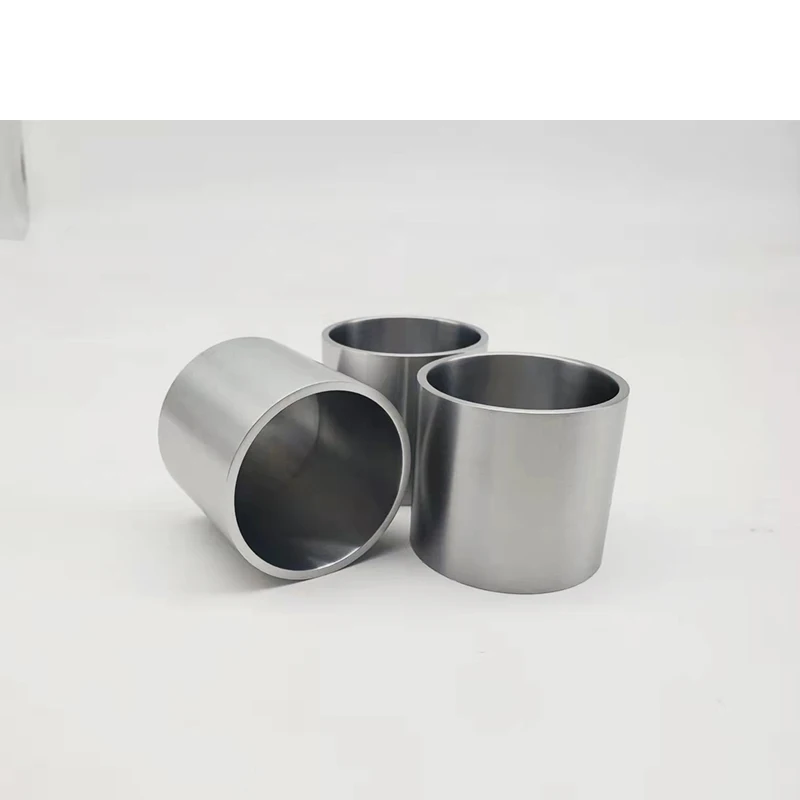
Choosing the correct wall and bottom thickness is one of the most important decisions when designing a custom molybdenum crucible for high-temperature applications.
Molybdenum crucibles are used in selected vacuum furnace, rare earth metallurgy, metal melting, and other controlled-atmosphere thermal processes because of their high melting point, thermal conductivity, and useful high-temperature mechanical properties.
However, even when the correct material is selected, an unsuitable crucible design can lead to deformation, cracking, localized wall damage, excessive material consumption, or premature replacement.
A thicker crucible is not always a better crucible.
The correct thickness depends on the relationship between crucible dimensions, operating temperature, molten material, mechanical loading, support conditions, and production cycles.
This guide explains how engineers and purchasing teams can evaluate wall thickness and bottom thickness before ordering a custom molybdenum crucible.
1. Why Wall Thickness Matters in Molybdenum Crucible Design
Wall thickness affects the structural behavior of a crucible during high-temperature operation.
If the wall is insufficient for the intended application, potential problems may include:
- Wall deformation under mechanical or thermal loading
- Loss of dimensional stability
- Greater sensitivity to localized material loss
- Reduced handling strength
- Premature failure during repeated operation
However, increasing wall thickness also increases the amount of molybdenum required.
This affects crucible weight, material cost, thermal mass, and potentially the heating and cooling behavior of the component.
For this reason, wall thickness should be selected based on engineering requirements rather than simply choosing the thickest available design.
Factors That Influence Wall Thickness
Important parameters include:
- Outer diameter and inner diameter
- Crucible height
- Maximum operating temperature
- Molten material composition
- Material weight and fill height
- Furnace atmosphere
- Heating and cooling conditions
- Crucible support and handling method
- Expected service cycle
These factors should be evaluated together.
2. Why Bottom Thickness Is Equally Important
The bottom of a molybdenum crucible performs a different structural function from the sidewall.
While the sidewall contains the material, the bottom transfers the weight of the crucible contents to the furnace support structure.
Depending on the design, the bottom may experience:
- Mechanical loading from the contained material
- Bending stress caused by its support arrangement
- Temperature gradients
- Localized chemical interaction
- Repeated thermal cycling
The bottom thickness must therefore be evaluated independently from the wall thickness.
Should the Bottom Always Be Thicker Than the Wall?
Not necessarily.
Some crucible designs use a thicker bottom because additional structural capacity is required.
Other designs may use similar wall and bottom thicknesses where the loading and support conditions permit.
There is no universal wall-to-bottom thickness ratio suitable for every molybdenum crucible.
The correct design depends on the crucible diameter, material load, support arrangement, temperature, and manufacturing method.
3. How Crucible Diameter Affects Wall Thickness
Crucible diameter is an important geometric factor.
As the diameter increases, the crucible geometry changes in ways that can influence structural behavior.
A larger crucible may require additional consideration of:
- Sidewall rigidity
- Bottom bending
- Mechanical loading
- Thermal expansion
- Support arrangement
- Handling requirements
For example, two crucibles may have the same wall thickness but very different diameters.
Their structural performance should not be assumed to be identical.
Example
Consider two cylindrical molybdenum crucibles:
Crucible A
Outer diameter: 100 mm
Wall thickness: 5 mm
Crucible B
Outer diameter: 200 mm
Wall thickness: 5 mm
Although both have the same wall thickness, Crucible B has a larger diameter and may experience different mechanical and thermal conditions.
Whether either design is suitable depends on its height, load, temperature, support, and other operating parameters.
Engineering takeaway: Wall thickness should be evaluated in relation to crucible diameter, not as an isolated dimension.
4. How Crucible Height Influences Design
Crucible height is another important consideration.
A taller crucible may introduce additional structural and handling requirements.
These can include:
- Greater sidewall height
- Increased potential fill volume
- Different thermal gradients
- Additional handling and installation considerations
- Greater sensitivity to certain deformation modes
However, crucible height alone does not determine the required wall thickness.
The actual fill height, material density, operating temperature, and support conditions are also important.
For high-temperature production, engineers should evaluate the complete crucible geometry rather than relying on one dimension.
5. Operating Temperature and High-Temperature Deformation
Molybdenum has a melting point of approximately 2,623°C.
However, this does not mean a finished molybdenum crucible can safely operate at any temperature below its melting point.
At elevated temperatures, material strength and deformation behavior depend on temperature, time, microstructure, and mechanical loading.
Under sustained loading, time-dependent deformation may become relevant.
This is particularly important for large crucibles or applications involving long holding periods.
What Should Be Considered?
Before selecting wall and bottom thickness, confirm:
- Normal operating temperature
- Maximum operating temperature
- Holding time
- Heating and cooling cycle
- Mechanical load
- Material grade and manufacturing condition
The allowable operating conditions should be evaluated using relevant material data and the actual crucible design.
A thicker wall may improve structural capacity in some situations, but it cannot compensate for every temperature-related limitation.
6. Molten Material Weight and Crucible Capacity
The amount of material contained inside a crucible affects the mechanical load.
For example, a crucible containing a small quantity of material may have different structural requirements from a larger crucible holding a much heavier charge.
The density of the processed material also matters.
A crucible designed for one material should not automatically be assumed suitable for another material with different density, chemistry, or operating temperature.
Estimating Required Capacity
For a simplified cylindrical internal cavity:
Internal Volume = π × (Internal Diameter ÷ 2)² × Usable Fill Height
When all dimensions are in centimeters, the result is in cubic centimeters (cm³).
The approximate mass of a fully specified liquid volume can then be estimated using:
Material Mass = Volume × Density
The density must correspond to the processed material at the relevant temperature.
Actual operating capacity should also account for freeboard, fill limits, and process requirements.
This calculation estimates capacity only. It does not establish whether the crucible wall or bottom is structurally adequate.
7. Thin-Wall vs Thick-Wall Molybdenum Crucibles
Both thin-wall and thick-wall crucibles can be appropriate depending on the application.
| Design Factor | Thin-Wall Crucible | Thick-Wall Crucible |
|---|---|---|
| Material consumption | Lower | Higher |
| Component weight | Lower | Higher |
| Initial material cost | Generally lower | Generally higher |
| Structural capacity | Requires careful evaluation | May offer additional capacity depending on design |
| Thermal mass | Lower | Higher |
| Manufacturing requirements | Thin sections may be challenging | Thick sections may require more machining |
| Typical selection basis | Process-specific | Process-specific |
A thick-wall design is not automatically more resistant to chemical attack or thermal shock.
Similarly, a thin-wall crucible is not automatically unsuitable for high-temperature operation.
The appropriate design depends on the full operating environment.
8. How Furnace Support Conditions Affect Bottom Thickness
Bottom thickness cannot be evaluated correctly without understanding how the crucible is supported.
For example, a crucible may rest on:
- A continuous support surface
- A support ring
- Several discrete support points
- A specially designed furnace fixture
These arrangements can create different mechanical loading conditions.
A crucible supported around its perimeter may experience different bottom bending stresses from one supported across a larger portion of its base.
The support material and its thermal expansion behavior should also be considered.
Important Design Question
How is the crucible supported inside the furnace?
This information is particularly important for large-diameter crucibles and heavily loaded applications.
Increasing bottom thickness without evaluating the support arrangement may not address the actual structural problem.
9. How to Calculate the Approximate Weight of a Molybdenum Crucible
Crucible weight is important for cost estimation, furnace loading, transportation, and handling.
For a simple open-top cylindrical crucible with a flat bottom and uniform sidewall thickness, the material volume can be estimated using:
Material Volume = Outer Cylinder Volume − Internal Cavity Volume
Assuming:
- OD = Outer diameter
- ID = Inner diameter
- H = Total external height
- B = Bottom thickness
The approximate material volume is:
V = (π/4) × [OD² × H − ID² × (H − B)]
All dimensions must use the same unit.
When dimensions are expressed in centimeters, the calculated volume is in cm³.
The approximate weight is then:
Weight = Volume × Material Density
The room-temperature density of molybdenum is approximately 10.2 g/cm³.
Example Calculation
Assume the following crucible dimensions:
- Outer diameter: 160 mm
- Inner diameter: 140 mm
- Total height: 120 mm
- Bottom thickness: 10 mm
The approximate material volume is:
V = (π/4) × [16² × 12 − 14² × 11]
V ≈ 719.4 cm³
Using a nominal molybdenum density of 10.2 g/cm³:
Approximate weight ≈ 7.34 kg
This is a theoretical estimate for a simplified cylindrical design.
Actual finished weight may vary due to machining allowances, corner radii, surface features, material density, and manufacturing tolerances.
Important: Weight calculation is useful for estimating material consumption and cost, but it does not replace structural design verification.
10. Common Mistakes in Molybdenum Crucible Thickness Design
Mistake 1: Selecting Wall Thickness Only by Diameter
Diameter is important, but temperature, height, load, and support conditions must also be considered.
Mistake 2: Assuming the Bottom Must Always Be Much Thicker
A thicker bottom may be appropriate in some applications, but there is no universal thickness ratio.
Mistake 3: Ignoring the Actual Operating Temperature
A crucible design that performs satisfactorily under one temperature and load condition may not perform the same way under another.
Mistake 4: Increasing Thickness to Solve Chemical Corrosion
If the crucible material is chemically incompatible with the melt, additional thickness may only delay failure rather than eliminate the cause.
Mistake 5: Ignoring Manufacturing Feasibility
Very thin walls, deep cavities, complex geometries, and tight tolerances may introduce manufacturing challenges.
Mistake 6: Providing Incomplete Drawings
Missing bottom thickness, unclear dimensional references, or unspecified tolerances can lead to quotation errors and manufacturing misunderstandings.
11. Manufacturing Considerations for Custom Molybdenum Crucibles
The manufacturing process should be considered during crucible design.
Depending on the size, geometry, and required material condition, molybdenum crucibles may be produced through suitable powder-metallurgy, forming, machining, or fabrication routes.
Important manufacturing considerations include:
- Raw material purity
- Material density and microstructure
- Wall thickness consistency
- Bottom thickness accuracy
- Machining allowances
- Surface condition
- Dimensional tolerances
- Inspection requirements
For some designs, machining a thick blank into a deep, thin-wall cavity may create manufacturing difficulties or unnecessary material waste.
Other manufacturing routes may be more appropriate depending on the required dimensions and properties.
The selected process should be confirmed with the manufacturer before finalizing the design.
12. How to Specify Wall and Bottom Thickness on a Drawing
A clear technical drawing helps reduce misunderstandings between the customer and manufacturer.
For a cylindrical crucible, the drawing should identify:
OD — Outer Diameter
ID — Inner Diameter
H — Total Height
T — Wall Thickness
B — Bottom Thickness
For a simple uniform-wall cylindrical design:
T = (OD − ID) ÷ 2
This relationship applies only when the geometry and dimensional definitions are consistent with that assumption.
Example Drawing Specification
Material: Molybdenum (Mo)
Outer Diameter: 160 mm
Inner Diameter: 140 mm
Total Height: 120 mm
Wall Thickness: 10 mm
Bottom Thickness: 10 mm
Quantity: 5 pcs
Surface Finish: According to drawing
Dimensional Tolerances: According to agreed manufacturing requirements
The drawing should also indicate any special requirements for corner radii, flatness, concentricity, surface condition, or inspection.
13. What If the Existing Crucible Is Deforming or Cracking?
If an existing molybdenum crucible experiences premature failure, increasing wall or bottom thickness should not be the first automatic response.
The failure mechanism should be investigated.
For example:
If the bottom deforms:
Check the operating load, temperature, support arrangement, and bottom geometry.
If the sidewall deforms:
Check temperature, wall geometry, fill conditions, and mechanical loading.
If cracking occurs:
Review thermal cycling, handling, material condition, and local stress concentrations.
If the wall becomes thinner:
Investigate possible chemical interaction, localized attack, or mecha