

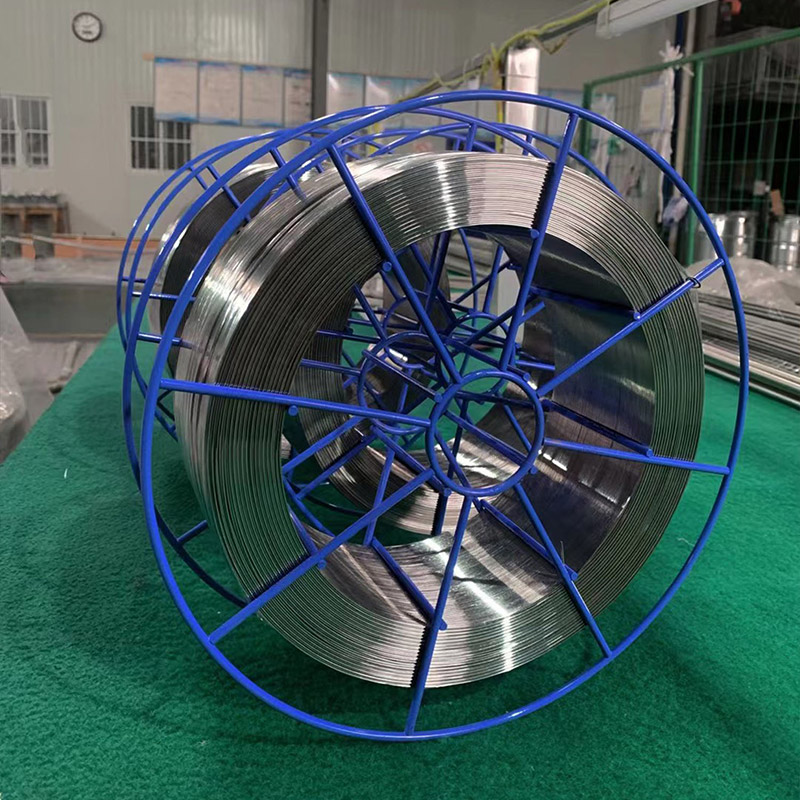
You may have heard of titanium alloys—used in aerospace, medical implants, and high-end sports equipment. But did you know that when titanium is drawn into fine wire, its applications become incredibly diverse?
What is Titanium Wire?
Titanium wire, as the name suggests, is a wire made from high-purity titanium or titanium alloys. Its diameter can range from a few microns to several millimeters. Though seemingly ordinary, it demonstrates remarkable “superpowers” across many fields.
Four Core Advantages of Titanium Wire
- High specific strength: Titanium’s density is only about 60% that of steel, yet its strength rivals many steels, making it an ideal combination of lightweight and high strength.
- Exceptional corrosion resistance: Titanium forms a dense oxide layer on its surface, resisting seawater, chloride ions, acids, alkalis, and other harsh environments.
- Excellent biocompatibility: Titanium is non-toxic and hypoallergenic, and it integrates well with bone (osseointegration).
- Temperature stability: Titanium wire maintains stable mechanical properties between -200°C and 500°C.
Main Applications of Titanium Wire
- Medical Field: “The Thread of Life”
- Orthodontic wires: Titanium wires used in dental braces are elastic, resistant to deformation, and free from nickel or other allergenic components, making them ideal for orthodontic treatment.
- Orthopedic sutures: Used for closing the sternum or tendon repair, titanium sutures are lighter, more fatigue-resistant, and do not interfere with CT or MRI scans.
- Intravenous guidewires and stents: Ultra-fine titanium wires can serve as guidewires for minimally invasive procedures or as frameworks for vascular stents.
- Artificial ligaments and suture anchors: Titanium wires can be woven into flexible structures to aid in sports injury repair.
- Aerospace and Defense: “The Pillars in Extreme Conditions”
- Antennas and conductive springs: On satellites and drones, where weight reduction is critical, titanium wire can serve as elastic antennas or connectors.
- Aerospace fasteners and woven meshes: Used for fixing and protecting components such as aircraft engine heat shields and tail nozzles.
- Ejection systems and ropes: Titanium wire ropes are strong, flame-resistant, and used in pilot ejection seats or other emergency systems.
- Marine Engineering: “The Rust-Free Deep-Sea Weapon”
- Fishing lines and hooks: High-end titanium fishing lines have high tensile strength, memory-free (resistant to curling), and never rust in seawater.
- Marine cable armoring: Titanium wires protect undersea cables from pressure and biological damage in deep-sea exploration or submarine communication.
- Seawater filters: Used in shipboard piping and desalination equipment for filtering components.
- Chemical and Energy Industries: “The Corrosion Guardian”
- Electrode materials: Titanium wire can serve as electrode grids for electrochemical water treatment and chlor-alkali production.
- Catalyst carriers: Titanium wire meshes support catalysts in high-temperature, corrosive reactions, such as waste gas purification or chemical processing.
- Fuel cell bipolar plate components: Some new titanium wire structures enhance conductivity and corrosion resistance.
- Consumer Electronics and Daily Products
- Eyewear frames: Titanium wire frames are ultra-light, bendable, and corrosion-resistant, making them highly popular.
- Headphone and speaker diaphragms: High-end headphones use ultra-fine titanium wire skeletons to improve high-frequency response.
- Electronic cigarette heating wires: Titanium wires maintain stable temperatures without producing off-flavors in dry-burn mode.
- Jewelry and accessories: Titanium wire can be anodized into various colors, creating lightweight, hypoallergenic, and personalized jewelry.
- 3D Printing and Advanced Manufacturing
- Additive manufacturing materials: Titanium wire can be directly fed into electron beam or laser melting equipment for printing aerospace blades or custom orthopedic implants.
- Welding filler material: Precision welding of titanium alloy structures requires matching titanium wire as filler.
Future Outlook
With advances in materials science, titanium wire is evolving toward finer, purer, and more functional forms, such as:
- Shape-memory titanium wire (e.g., NiTi): Automatically returns to its original shape at body temperature, used in smart textiles or cardiac occluders.
- Nanotitanium wire arrays: Applied in efficient water electrolysis for hydrogen production or in novel sensors.
Conclusion
From your braces to deep-sea submersibles, to satellites soaring in the sky—titanium wire, though fine, plays a crucial role. Unlike bulk titanium, it quietly supports modern high-end manufacturing with its flexibility, lightness, and corrosion resistance.
Next time you wear titanium glasses or hear about a “never-rusting” fishing line, remember: these hair-thin metal threads are silently delivering their “hardcore power,” making many of the conveniences and innovations in our lives possible.