
Titanium bars are widely used in industries where high strength, corrosion resistance, and lightweight performance are required.
Among international titanium standards, ASTM B348 is one of the most commonly specified standards for titanium bars and billets.
Engineers, manufacturers, and purchasing teams often specify ASTM B348 titanium bars for applications including:
- Aerospace components
- Chemical processing equipment
- Marine engineering
- Medical devices
- Precision machining
- Industrial tooling
Understanding ASTM B348 requirements, titanium grades, product forms, and applications helps buyers select the right material for their projects.
What Is ASTM B348 Titanium Bar?
ASTM B348 is the standard specification established by ASTM International for:
Titanium and Titanium Alloy Bars and Billets
This specification defines requirements for:
- Chemical composition
- Mechanical properties
- Heat treatment
- Dimensions
- Tolerances
- Surface conditions
- Testing requirements
Titanium bars manufactured according to ASTM B348 are widely accepted in global industrial markets.
Common Titanium Grades Under ASTM B348
ASTM B348 covers commercially pure titanium grades and titanium alloys.
The most commonly requested grades include:
Grade 1 Titanium Bar
Grade 1 is commercially pure titanium with the highest ductility among CP titanium grades.
Characteristics:
- Excellent corrosion resistance
- Excellent formability
- Excellent weldability
- Lower strength compared with alloy grades
Applications:
- Chemical equipment
- Heat exchangers
- Marine components
- Fabricated structures
Grade 2 Titanium Bar
Grade 2 is the most widely used commercially pure titanium grade.
It provides an excellent balance between:
- Strength
- Corrosion resistance
- Fabrication capability
Applications:
- Chemical processing
- Pressure vessels
- Piping systems
- Heat exchangers
- Desalination equipment
For many industrial applications, Grade 2 titanium bar is considered the standard choice.
Grade 5 Titanium Bar (Ti-6Al-4V)
Grade 5 is the most popular titanium alloy worldwide.
Chemical composition:
- Titanium balance
- Aluminum approximately 6%
- Vanadium approximately 4%
Advantages:
- High tensile strength
- Excellent fatigue resistance
- Lightweight
- Good mechanical performance
Applications:
- Aerospace components
- CNC machining parts
- Fasteners
- Medical implants
- High-performance engineering components
Grade 5 titanium round bar is one of the most commonly purchased titanium products globally.
Grade 7 Titanium Bar
Grade 7 contains palladium, improving corrosion resistance in certain chemical environments.
Applications:
- Chemical processing
- Acid environments
- Specialized industrial equipment
Grade 9 Titanium Bar
Grade 9 is a titanium alloy containing aluminum and vanadium.
It provides:
- Higher strength than CP titanium
- Better corrosion resistance
- Good formability
Applications:
- Tubing systems
- Aerospace components
- Sporting equipment
ASTM B348 Titanium Bar Product Forms
Titanium bars are available in different shapes depending on customer requirements.
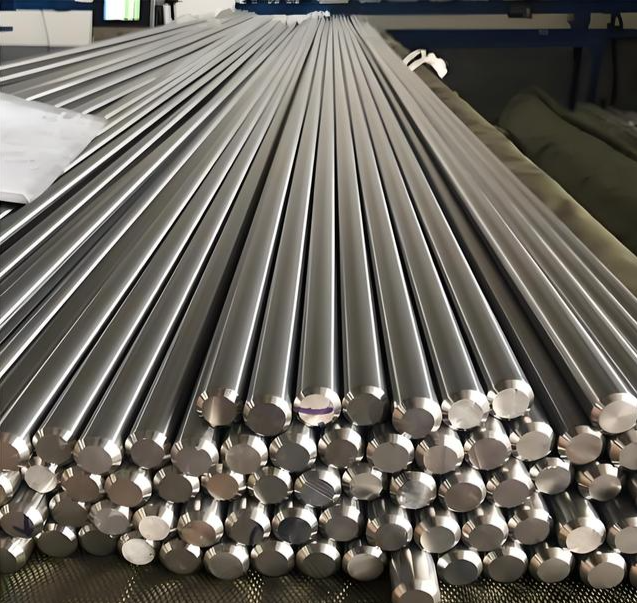
Titanium Round Bar
The most common product form.
Applications:
- CNC machining
- Shafts
- Fasteners
- Components
Common diameters:
- 5 mm
- 10 mm
- 20 mm
- 50 mm
- 100 mm+
(Custom sizes available)
Titanium Square Bar
Used for:
- Structural components
- Machining blanks
- Custom fabrication
Titanium Hex Bar
Used for:
- Precision machining
- Fasteners
- Special components
Titanium Forged Bar
Used for heavy-duty applications requiring:
- Higher strength
- Better internal structure
- Large dimensions
ASTM B348 Titanium Bar Mechanical Properties
Mechanical properties vary depending on grade and heat treatment.
Typical comparison:
| Grade | Tensile Strength | Main Advantage |
|---|---|---|
| Grade 1 | Lower | Maximum corrosion resistance |
| Grade 2 | Medium | Balance of strength and corrosion resistance |
| Grade 5 | High | Superior strength-to-weight ratio |
| Grade 9 | Medium-High | Strength + formability |
Titanium Bar Surface Conditions
ASTM B348 titanium bars can be supplied with different surface finishes.
Common options include:
Black Surface
Usually from hot forging or hot rolling.
Suitable for:
- Further machining
- Industrial processing
Pickled Surface
Oxide layer removed through chemical treatment.
Advantages:
- Cleaner surface
- Improved appearance
Machined Surface
Used when customers require:
- Precise dimensions
- Better surface finish
- CNC processing
Polished Surface
Used for:
- Decorative applications
- Precision components
Titanium Bar Applications
Aerospace Industry
Titanium bars are used for:
- Aircraft components
- Structural parts
- Fasteners
- Engine-related components
Reasons:
- Lightweight
- High strength
- Fatigue resistance
Chemical Processing Industry
Applications include:
- Pumps
- Valves
- Shafts
- Reactor components
Titanium provides excellent resistance to:
- Chlorides
- Chemical solutions
- Corrosive environments
Marine Engineering
Titanium bars are used in:
- Marine equipment
- Offshore components
- Seawater systems
Advantages:
- Excellent seawater corrosion resistance
- Long service life
Medical Industry
Grade 5 titanium bars are commonly used for:
- Medical implants
- Surgical instruments
- Precision components
Because titanium is:
- Biocompatible
- Lightweight
- Corrosion resistant
Industrial Machining
Titanium round bars are widely used for CNC machining.
Typical parts:
- Screws
- Bolts
- Connectors
- Custom components
ASTM B348 Titanium Bar vs Stainless Steel Bar
| Property | Titanium Bar | Stainless Steel Bar |
|---|---|---|
| Density | Lower | Higher |
| Weight | Lightweight | Heavier |
| Corrosion Resistance | Excellent | Good |
| Strength-to-weight Ratio | Higher | Lower |
| Cost | Higher | Lower |
| Service Life | Longer in harsh environments | Depends on grade |
Titanium is often selected when performance and durability are more important than initial material cost.
How to Choose the Right ASTM B348 Titanium Bar?
Before purchasing titanium bars, consider:
1. Application Environment
Is the material exposed to:
- Seawater?
- Chemicals?
- High temperature?
- Vacuum environment?
2. Required Strength
For high-load applications:
Choose:
- Grade 5
- Grade 9
For corrosion-focused applications:
Choose:
- Grade 1
- Grade 2
3. Machining Requirements
For CNC machining:
Consider:
- Diameter tolerance
- Surface condition
- Material certification
4. Certification Requirements
Industrial buyers may require:
- Material Test Certificate (MTC)
- Chemical analysis report
- Mechanical test report
- Ultrasonic testing
- Dimensional inspection
ASTM B348 Titanium Bar Manufacturing Capability
Shaanxi Metres Metals Manufacturing Co., Ltd. supplies ASTM B348 titanium bars for global industrial applications.
Our titanium bar products include:
- Titanium Round Bar
- Titanium Rod
- Titanium Square Bar
- Titanium Forged Bar
- Custom Titanium Components
Available grades:
- Grade 1
- Grade 2
- Grade 5 (Ti-6Al-4V)
- Grade 7
- Grade 9
We support customized:
- Diameter
- Length
- Surface finish
- Machining requirements
Products can be supplied with inspection documents according to customer requirements.
Frequently Asked Questions
What is ASTM B348?
ASTM B348 is the international standard specification for titanium and titanium alloy bars and billets.
What is the most common titanium bar grade?
Grade 5 titanium bar (Ti-6Al-4V) is the most widely used titanium alloy bar because of its excellent strength-to-weight ratio.
Is Grade 2 titanium bar corrosion resistant?
Yes. Grade 2 titanium provides excellent corrosion resistance and is widely used in chemical and marine applications.
Can titanium bars be CNC machined?
Yes. Titanium bars can be CNC machined into precision components with appropriate tooling and machining parameters.
Conclusion
ASTM B348 titanium bar is one of the most important titanium products used in modern industries.
By understanding titanium grades, mechanical properties, applications, and purchasing requirements, engineers can select the correct titanium bar for their specific projects.
Whether the requirement is corrosion resistance, lightweight strength, or precision machining performance, ASTM B348 titanium bars provide a reliable solution for demanding industrial applications.