
Introduction
Rare earth metallurgy is one of the most demanding fields in modern metal production.
The production of Neodymium (Nd), Praseodymium (Pr), NdPr alloy, Lanthanum (La), and Cerium (Ce) requires precise control of:
- Chemical composition
- Temperature
- Electrochemical conditions
- Material interaction
- Process stability
Many manufacturers focus on raw materials and production equipment.
However, one important factor is often overlooked:
Every component that contacts molten rare earth materials can influence contamination control.
From sampling ladles to crucibles and electrodes, high-temperature tools play an important role in maintaining stable production.
Why Contamination Control Is Critical in Rare Earth Processing
Rare earth materials are widely used in high-performance applications such as:
- Permanent magnets
- Electric motors
- Renewable energy systems
- Advanced electronic components
Because downstream applications require strict material performance, production processes must maintain consistent quality.
During rare earth metallurgy, unwanted contamination may come from:
- Raw materials
- Furnace environment
- Electrolyte system
- Crucible materials
- Electrodes
- Sampling tools
Even small process variations can affect:
- Chemical analysis accuracy
- Metal purity
- Production consistency
- Final material performance
Therefore, contamination control should be considered throughout the entire production process.
Where Can Contamination Occur?
1. During Molten Metal Sampling
Sampling is one of the most direct contact points between tools and molten rare earth metals.
The sampling ladle contacts the molten material during:
- Collection
- Transfer
- Temporary holding
Potential issues include:
- Tool surface reaction
- Material degradation
- Residual contamination
- Inconsistent sampling results
A suitable sampling tool material helps reduce unnecessary risks.
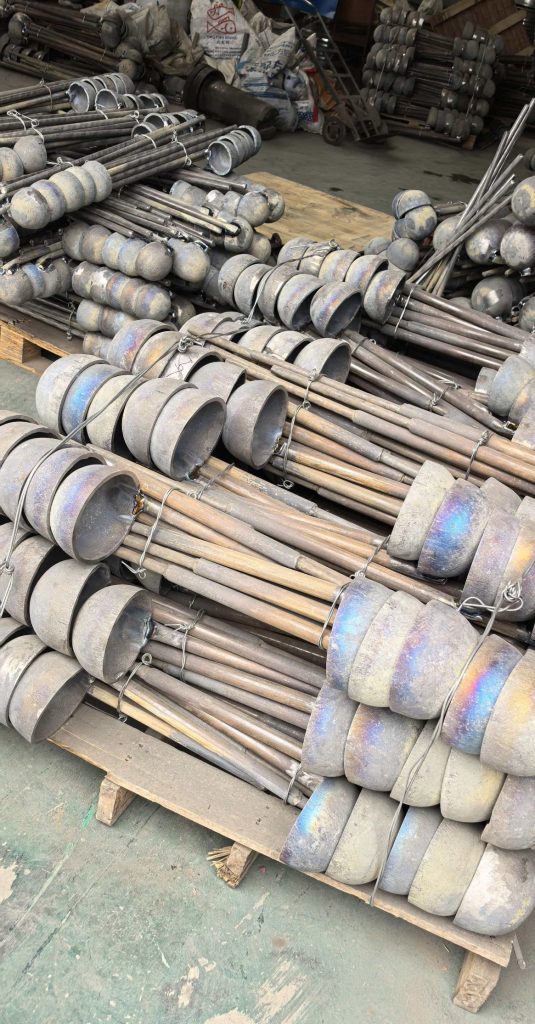
Titanium Alloy Sampling Ladles for Cleaner Sampling
Titanium alloy sampling ladles are widely used in demanding molten metal sampling applications because of their combination of:
- Corrosion resistance
- High strength-to-weight ratio
- Lightweight operation
- Stable performance during repeated use
A properly designed titanium sampling ladle helps support:
- More consistent sampling
- Easier operator handling
- Reduced replacement frequency
- Better process monitoring
However, material selection should always match the actual molten metal type and operating conditions.
2. During Molten Metal Containment
Crucibles are another critical component in high-temperature metallurgy.
A crucible directly contacts molten materials for extended periods.
Poor material selection may result in:
- Shorter service life
- Structural damage
- Increased contamination risk
- Production interruption
Common high-temperature crucible materials include:
Molybdenum Crucibles
Molybdenum is widely used because of:
- High melting point
- Good thermal conductivity
- Excellent balance between performance and cost
It is commonly selected for many high-temperature industrial applications.
Tungsten Crucibles
Tungsten provides:
- Extremely high temperature capability
- Excellent mechanical stability
- Strong performance in demanding environments
It is often considered for more severe operating conditions.
Material Selection Depends on Application
The best crucible material depends on:
- Operating temperature
- Atmosphere condition
- Molten material characteristics
- Production requirements
There is no single material suitable for every process.
3. During Rare Earth Electrolysis
Electrodes are another important factor affecting process stability.
In rare earth electrolysis, the cathode operates continuously under:
- High temperature
- Electrical load
- Molten salt environment
A stable cathode helps maintain:
- Consistent current distribution
- Reliable metal deposition
- Longer operating cycles
Tungsten Cathodes in Rare Earth Electrolysis
Tungsten is selected for many high-temperature electrode applications because of:
- Extremely high melting point
- High-temperature strength
- Dimensional stability
- Resistance to severe operating conditions
A properly designed tungsten cathode can help improve electrolysis reliability and reduce electrode-related problems.
Important design factors include:
- Diameter
- Length
- Surface condition
- Tungsten purity
- Operating parameters
High-Temperature Tools Are Part of Process Control
In modern rare earth production, tools should not be viewed as simple consumable parts.
They are part of the complete metallurgical system.
A reliable production process requires coordination between:
Material Selection
Choosing materials compatible with the process environment.
Engineering Design
Optimizing dimensions, structure, and operating performance.
Process Management
Maintaining stable temperature, atmosphere, and operating procedures.
How to Reduce Contamination Risks in Rare Earth Metallurgy
Plants can improve contamination control through:
1. Selecting Suitable Contact Materials
Choose materials according to:
- Temperature
- Chemical environment
- Service requirements
2. Using Customized Tool Designs
Standard products may not always fit specific production conditions.
Customized designs consider:
- Furnace structure
- Sampling requirements
- Production cycle
- Operator needs
3. Maintaining Tool Condition
Regular inspection helps identify:
- Surface damage
- Deformation
- Cracks
- Excessive wear
Replacing damaged tools before failure improves production reliability.
A Complete High-Temperature Tool Solution
Rare earth metallurgy requires cooperation between multiple high-temperature components:
Sampling Stage
Titanium alloy sampling ladles help collect representative molten metal samples.
Holding Stage
Tungsten and molybdenum crucibles provide stable containment under high temperatures.
Electrolysis Stage
Tungsten cathodes support stable electrochemical operation.
Together, these components contribute to better process control and production consistency.
Conclusion
Rare earth metallurgy requires more than advanced furnaces and high-quality raw materials.
Every high-temperature component that contacts molten materials can influence process stability and contamination control.
Selecting suitable materials such as titanium alloy, tungsten, and molybdenum, combined with proper engineering design, helps manufacturers achieve more reliable production.
For rare earth producers working with Nd, Pr, NdPr, La, and Ce systems, high-temperature tools are not simply accessories.
They are essential parts of the metallurgical process.
Need High-Temperature Metallurgical Tools for Rare Earth Production?
We provide customized solutions including:
- Titanium alloy sampling ladles
- Tungsten cathode rods
- Molybdenum crucibles
- Tungsten-molybdenum crucibles
To recommend the right solution, please provide:
- Material being processed
- Working temperature
- Furnace or electrolysis system information
- Required dimensions
- Existing drawings or specifications
Our engineering team can support customized high-temperature component design for rare earth metallurgy applications.