
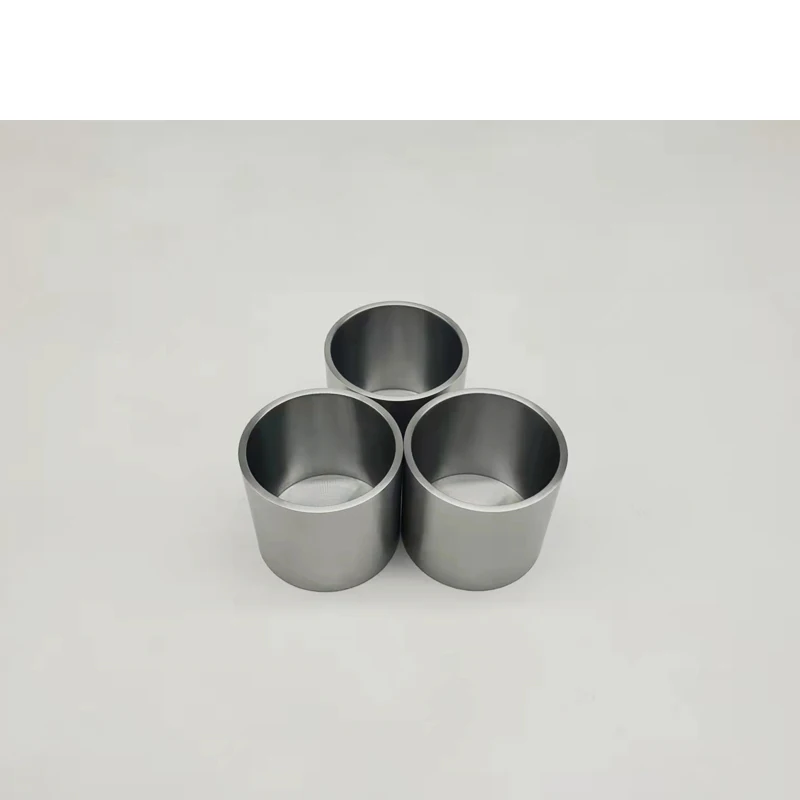
Choosing the right crucible material is an important engineering decision in rare earth metal production.
Depending on the process, a crucible may be exposed to high temperatures, reactive molten metals, repeated thermal cycles, and demanding operating conditions.
Molybdenum and tungsten are two refractory metals considered for certain high-temperature rare earth metallurgical applications.
Both offer high melting points and useful high-temperature properties. However, they differ in density, thermal behavior, mechanical characteristics, manufacturing requirements, and cost.
More importantly, a higher melting point does not automatically mean better performance in every rare earth melting application.
The appropriate crucible material depends on the actual process conditions, including the metal being processed, operating temperature, furnace atmosphere, chemical compatibility, crucible geometry, and expected service life.
This guide compares molybdenum and tungsten crucibles from a practical engineering perspective and explains what information should be evaluated before selecting a crucible for rare earth metal production.
1. Understanding Crucible Requirements in Rare Earth Metal Production
Rare earth metal production involves different process routes and operating environments.
Some facilities produce rare earth oxides or other compounds without producing molten rare earth metals. Others convert rare earth compounds into metals or alloys through processes that may include molten-salt electrolysis, reduction, melting, or alloy preparation.
These operations do not necessarily use the same crucible materials or equipment.
For applications involving molten rare earth metals, crucible selection should begin with the following questions:
- What metal or alloy will the crucible contain?
- What is the normal and maximum operating temperature?
- Is the process conducted under vacuum, an inert atmosphere, or another controlled environment?
- How long will the molten material remain in contact with the crucible?
- Will the crucible experience repeated heating and cooling?
- What dimensions and capacity are required?
- What is the acceptable level of contamination?
The answers provide a more reliable basis for material selection than choosing a crucible solely by its melting point.
2. Molybdenum vs Tungsten: Key Material Properties
Molybdenum and tungsten belong to the refractory metal family, but their physical properties are different.
The following table provides an initial comparison.
| Property | Molybdenum (Mo) | Tungsten (W) |
|---|---|---|
| Melting point | Approximately 2,623°C | Approximately 3,422°C |
| Density at room temperature | Approximately 10.2 g/cm³ | Approximately 19.3 g/cm³ |
| High-temperature capability | High | Very high |
| Thermal conductivity | High | High |
| Weight at identical volume | Lower | Higher |
| Machining and fabrication | Generally less demanding than tungsten | Often more demanding |
| Raw material cost | Depends on market conditions | Depends on market conditions |
| High-temperature oxidation | Requires atmosphere control | Requires atmosphere control |
Note: These are general material characteristics, not guaranteed crucible operating limits. Actual performance depends on material grade, manufacturing route, temperature, atmosphere, loading, and chemical environment.
What Does This Mean for Crucible Selection?
Tungsten has a substantially higher melting point than molybdenum.
However, crucible performance is not determined by melting point alone.
For example, if a process operates at a temperature within the capability of both materials, factors such as chemical compatibility, crucible dimensions, structural stability, manufacturing feasibility, and total operating cost may become more important.
The material with the highest melting point is not necessarily the most suitable material for the specific application.
3. Operating Temperature: When Does Tungsten’s Higher Melting Point Matter?
Temperature is one of the first parameters engineers consider when selecting a refractory-metal crucible.
Molybdenum has a melting point of approximately 2,623°C, while tungsten has a melting point of approximately 3,422°C.
This difference makes tungsten a candidate for applications requiring very high temperature capability.
However, these melting points should not be interpreted as the maximum safe operating temperatures of finished crucibles.
The actual operating limit depends on several factors, including:
- Furnace atmosphere
- Holding time
- Mechanical loading
- Crucible geometry
- Material grade and manufacturing condition
- Interaction with the processed material
A crucible can deform, react with its contents, or experience progressive material loss at temperatures far below its melting point.
When to Consider Molybdenum
Molybdenum may be considered when the operating temperature, atmosphere, load, and melt chemistry are compatible with the material.
Its lower density and comparatively less demanding manufacturing characteristics can also be useful when designing larger crucibles.
When to Consider Tungsten
Tungsten may be evaluated when higher temperature capability or particular high-temperature mechanical characteristics are required.
However, its greater density, manufacturing requirements, and chemical compatibility with the process must also be considered.
Engineering takeaway: Select the crucible according to the complete operating environment, not simply the highest temperature listed in a material data sheet.
4. Furnace Atmosphere: A Critical Factor for Both Materials
One of the most important considerations in refractory-metal crucible selection is the furnace atmosphere.
Both molybdenum and tungsten can oxidize at elevated temperatures when exposed to oxygen.
Consequently, their high melting points do not make them suitable for unrestricted high-temperature operation in air.
For many high-temperature applications, these materials are used under appropriately controlled conditions, such as vacuum or protective atmospheres.
The required atmosphere depends on the material, temperature, process chemistry, and equipment design.
Questions to Confirm Before Ordering
Is the furnace operated under vacuum or an inert gas?
Is the atmosphere controlled throughout heating, holding, and cooling?
Could the crucible be exposed to oxygen while it is still hot?
Are there process gases, moisture, or other reactive species that may interact with the crucible?
These questions are important because a crucible that performs satisfactorily under one atmosphere may behave very differently under another.
Neither molybdenum nor tungsten should be selected for a high-temperature application without confirming the atmosphere requirements.
5. Chemical Compatibility with Molten Rare Earth Metals
Chemical compatibility is often more important than the difference between the melting points of molybdenum and tungsten.
Rare earth metal production may involve neodymium (Nd), praseodymium (Pr), NdPr metal, lanthanum (La), cerium (Ce), and other rare earth materials.
However, different metals, alloys, molten salts, and process additives do not necessarily interact with crucible materials in the same way.
The behavior of a crucible depends on the complete chemical environment.
Potential concerns include:
- Reaction between the molten material and the crucible
- Dissolution or erosion of the crucible material
- Transfer of crucible-derived impurities into the melt
- Surface degradation
- Reduced crucible service life
Why Material Compatibility Must Be Evaluated Separately
A molybdenum crucible that performs well in one NdPr-related process should not automatically be assumed suitable for another rare earth metal or electrolyte.
Likewise, replacing molybdenum with tungsten does not automatically eliminate chemical compatibility problems.
For example, a change in melt composition, holding time, operating temperature, or electrolyte chemistry may alter the interaction between the molten material and the crucible.
Practical Selection Advice
Before selecting a crucible, provide the manufacturer with the actual material being processed.
Instead of stating:
“Rare earth melting application”
specify:
“NdPr metal melting under [atmosphere], at [temperature], with an approximate holding time of [duration].”
If the application involves molten salts, provide the electrolyte composition where possible.
This information helps determine whether molybdenum, tungsten, W-Mo alloy, or another material should be evaluated.
6. Crucible Weight: Why Density Matters
Molybdenum and tungsten have a significant density difference.
At room temperature:
Molybdenum: approximately 10.2 g/cm³
Tungsten: approximately 19.3 g/cm³
For two crucibles with identical dimensions and material volume, a tungsten crucible will weigh approximately 1.9 times as much as a molybdenum crucible.
This difference becomes important when manufacturing large crucibles.
Example: Comparing Identical Crucible Designs
Assume two crucibles have the same external dimensions, internal dimensions, wall thickness, and bottom thickness.
If the molybdenum crucible weighs approximately 8 kg, a tungsten crucible with the same material volume would weigh approximately 15 kg.
This is an illustrative density-based comparison, not the calculated weight of a particular crucible design.
Why Weight Matters
Additional weight may affect:
- Manual handling
- Lifting equipment
- Furnace support structure
- Installation and removal
- Transportation
- Total material consumption
For large crucibles, density should therefore be considered during the design stage.
A heavier crucible is not necessarily more durable or more suitable for the process.
7. Manufacturing and Machining Considerations
The manufacturing route is another important difference between molybdenum and tungsten crucibles.
Refractory-metal crucibles may be produced using powder-metallurgy processes, forming, sintering, machining, or other manufacturing methods, depending on the material and design.
The appropriate route depends on the required dimensions, wall thickness, tolerances, and finished material properties.
Molybdenum Crucibles
Molybdenum is generally less demanding to machine and fabricate than tungsten, although processing difficulty depends on the material condition and manufacturing route.
For custom crucibles, manufacturing considerations may include:
- Material purity
- Density
- Wall thickness
- Bottom thickness
- Surface finish
- Dimensional tolerances
- Required inspection
Tungsten Crucibles
Tungsten presents additional manufacturing challenges because of its material characteristics and processing requirements.
Large dimensions, thin walls, complex geometries, and tight tolerances may increase manufacturing difficulty.
This does not mean that complex tungsten crucibles cannot be manufactured.
It means that design feasibility should be evaluated before finalizing the drawing and quotation.
Important Purchasing Point
A crucible drawing that is practical in molybdenum may require a different manufacturing approach when the material is changed to tungsten.
Customers should confirm manufacturability before assuming that the same geometry can be produced in both materials under identical conditions.
8. Wall Thickness and Bottom Thickness
Crucible material selection and crucible geometry should be considered together.
Wall thickness affects structural stability, weight, material consumption, and the consequences of localized material loss.
Bottom thickness is also important because the bottom supports the process material and may experience different mechanical and thermal conditions from the sidewall.
Is a Thicker Crucible Always Better?
Not necessarily.
Increasing wall or bottom thickness can improve structural capacity in some designs, but it also increases weight, material consumption, thermal mass, and cost.
For a tungsten crucible, the weight increase can be particularly significant because of tungsten’s high density.
The correct design depends on the application.
Information Required for Design Evaluation
Engineers should consider the relationship between:
Crucible diameter + height + wall thickness + bottom thickness + load + operating temperature + support conditions
There is no universal wall-to-bottom thickness ratio that is suitable for every rare earth crucible.
For custom orders, the wall thickness and bottom thickness should be clearly specified on the drawing.
9. Thermal Cycling and Structural Stability
In industrial production, crucibles may experience repeated heating, holding, cooling, and reheating.
These thermal cycles can generate stress within the crucible.
Depending on the material condition and geometry, repeated thermal exposure may contribute to cracking, deformation, or other structural changes.
The risk is influenced by:
- Heating and cooling rates
- Temperature gradients
- Crucible geometry
- Material condition
- Mechanical loading
- Support method
Both molybdenum and tungsten crucibles should be evaluated for the actual thermal cycle.
A material’s melting point alone does not establish its resistance to thermal cycling or mechanical damage.
For applications involving frequent temperature changes, the operating procedure and crucible design should be reviewed together.
10. Molybdenum vs Tungsten Crucible Cost
Cost is an important consideration, especially for large crucibles or production lines that require multiple replacement components.
However, comparing the price per kilogram of molybdenum and tungsten is not enough.
The finished crucible price depends on:
- Material market price
- Material weight
- Manufacturing route
- Machining requirements
- Dimensional tolerances
- Inspection requirements
- Order quantity
Because tungsten is significantly denser than molybdenum, an identical crucible design requires substantially more material by weight.
Manufacturing difficulty may also influence the final price.
Purchase Price vs Total Operating Cost
A lower initial purchase price does not necessarily mean a lower cost per production cycle.
A more useful comparison is:
Total operating cost = Crucible purchase cost + replacement-related costs + other process costs attributable to the crucible
If reliable operating data is available, engineers can also compare the cost per successful production cycle.
However, it is important not to assume that a tungsten crucible will automatically last longer than a molybdenum crucible.
Service life must be evaluated under the actual operating conditions.
11. What About Tungsten-Molybdenum Alloy Crucibles?
In addition to pure molybdenum and pure tungsten, tungsten-molybdenum (W-Mo) alloys may be considered for selected high-temperature applications.
W-Mo crucibles are manufactured using specified combinations of tungsten and molybdenum.
Their properties depend on factors such as:
- Tungsten-to-molybdenum ratio
- Material purity
- Manufacturing route
- Density and microstructure
- Operating temperature
- Process environment
A W-Mo crucible should not automatically be assumed to provide the full advantages of both pure metals.
Its suitability must be evaluated according to the actual alloy composition and application.
When Should W-Mo Be Evaluated?
W-Mo may be worth evaluating when an existing crucible application has defined requirements that justify considering a different refractory-metal composition.
For example, engineers may wish to investigate whether a particular W-Mo grade provides an appropriate combination of manufacturing feasibility and high-temperature performance for their process.
However, changing the alloy composition should be supported by material data and application-specific evaluation.
For custom W-Mo crucibles, the alloy composition should be confirmed before quotation and manufacturing.
12. Molybdenum vs Tungsten vs W-Mo: Practical Selection Comparison
The following table summarizes the main considerations when evaluating these materials.
| Selection Factor | Molybdenum Crucible | Tungsten Crucible | W-Mo Crucible |
|---|---|---|---|
| Melting point | High | Higher than Mo | Depends on composition |
| Density | Lower than W | Higher than Mo | Depends on composition |
| Manufacturing | Generally less demanding than W | Often more demanding | Depends on composition and process |
| High-temperature oxidation | Requires atmosphere control | Requires atmosphere control | Requires atmosphere control |
| Chemical compatibility | Must be verified | Must be verified | Must be verified |
| Large-size production | Evaluate geometry and manufacturing route | Evaluate weight and manufacturing feasibility | Evaluate composition and manufacturing feasibility |
| Cost | Depends on material and manufacturing | Depends on material, weight and manufacturing | Depends on composition and manufacturing |
| Application suitability | Process-specific | Process-specific | Process-specific |
The purpose of this comparison is to identify the relevant engineering questions, not to establish a universal ranking of crucible materials.
13. Common Mistakes When Selecting a Rare Earth Crucible
Several purchasing mistakes can lead to unnecessary cost or premature component failure.
Mistake 1: Choosing Tungsten Only Because It Has a Higher Melting Point
A higher melting point does not guarantee better chemical compatibility or longer service life.
Mistake 2: Ignoring the Furnace Atmosphere
Both molybdenum and tungsten can oxidize at elevated temperatures.
The atmosphere must be considered before selecting either material.
Mistake 3: Comparing Crucibles Only by Price per Kilogram
The finished price also depends on density, geometry, manufacturing requirements, and inspection.
Mistake 4: Replacing Molybdenum with Tungsten Without Reviewing the Drawing
The same geometry may have different weight, manufacturing, and structural implications when the material changes.
Mistake 5: Assuming One Crucible Material Works for Every Rare Earth Metal
Different metals, alloys, electrolytes, and process conditions require separate compatibility evaluation.
Mistake 6: Ordering Without Explaining the Existing Failure Problem
If an existing crucible experiences cracking, deformation, contamination, or rapid wall loss, this information should be shared before ordering a replacement.
Simply changing the material may not address the underlying cause.
14. How to Choose the Right Crucible for Your Rare Earth Process
A practical selection process begins with identifying the actual application.
Step 1: Confirm the process route.
Determine whether the crucible will be used for melting, metal collection, alloy preparation, laboratory processing, or another operation.
Step 2: Identify the material being processed.
Specify the rare earth metal, alloy, molten salt, or other material that will contact the crucible.
Step 3: Confirm the temperature and atmosphere.
Provide normal and maximum operating temperatures, holding time, and furnace atmosphere.
Step 4: Evaluate material compatibility.
Review whether molybdenum, tungsten, W-Mo, or another material is appropriate for the process.
Step 5: Confirm the crucible geometry.
Provide the outer diameter, inner diameter, height, wall thickness, bottom thickness, and required capacity.
Step 6: Evaluate manufacturing feasibility.
Confirm whether the selected material and geometry can be manufactured to the required tolerances.
Step 7: Compare the complete operating cost.
Consider purchase price, expected service conditions, handling, inspection, and replacement requirements.
For a new application, trial production and inspection data may be necessary before establishing an expected service life.
15. Information to Provide When Requesting a Custom Crucible Quote
A complete technical inquiry helps the manufacturer evaluate the application and prepare a more accurate quotation.
| Parameter | Information to Provide |
|---|---|
| Application | Rare earth metal melting / alloy preparation / other |
| Material being processed | Nd / Pr / NdPr / La / Ce / other |
| Preferred crucible material | Mo / W / W-Mo / material selection required |
| Operating temperature | Normal and maximum temperature |
| Furnace atmosphere | Vacuum / inert gas / other |
| Holding time | Approximate duration per production cycle |
| Outer diameter | ___ mm |
| Inner diameter | ___ mm |
| Height | ___ mm |
| Wall thickness | ___ mm |
| Bottom thickness | ___ mm |
| Required capacity | ___ kg |
| Quantity | ___ pcs |
| Existing crucible problem | Cracking / deformation / wall thinning / contamination / other |
| Technical drawing | PDF / CAD / image |
If the crucible is intended to replace an existing component, photos of the used crucible can also help identify the location and type of damage.
16. Frequently Asked Questions
Is a tungsten crucible always better than a molybdenum crucible?
No. Tungsten has a higher melting point, but that does not guarantee better performance in every application.
The selection depends on temperature, atmosphere, melt chemistry, geometry, manufacturing requirements, and cost.
Can molybdenum crucibles be used for rare earth metal melting?
Molybdenum crucibles may be considered for suitable rare earth metallurgical applications.
However, compatibility must be evaluated for the specific metal or alloy, operating temperature, atmosphere, and contact time.
Can tungsten crucibles be used in air at high temperatures?
Tungsten can oxidize at elevated temperatures in the presence of oxygen.
Its high melting point does not eliminate the need for appropriate atmosphere control.
Are tungsten crucibles heavier than molybdenum crucibles?
Yes. Tungsten has a density of approximately 19.3 g/cm³, compared with approximately 10.2 g/cm³ for molybdenum.
At identical material volume, a tungsten crucible is approximately 1.9 times as heavy.
Is a W-Mo crucible better than a pure molybdenum crucible?
Not necessarily.
W-Mo properties depend on alloy composition and manufacturing conditions. Its suitability should be evaluated against the specific application rather than assumed from the presence of tungsten.
Can I replace my existing molybdenum crucible with a tungsten crucible of the same dimensions?
The same dimensions may be possible, but the replacement should be reviewed for weight, manufacturing feasibility, furnace support, thermal behavior, and chemical compatibility.
If the existing crucible has failed prematurely, the cause of failure should be investigated before changing materials.
What information is needed to manufacture a custom molybdenum or tungsten crucible?
At minimum, provide the required material, outer diameter, inner diameter, height, wall thickness, bottom thickness, quantity, and drawing.
For application-specific evaluation, also provide the processed material, temperature, atmosphere, holding time, and any existing failure problems.
Conclusion
Molybdenum and tungsten are both important refractory metals for selected high-temperature metallurgical applications.
Tungsten provides a higher melting point and greater density, while molybdenum offers lower weight and generally less demanding manufacturing characteristics.
However, neither material is universally suitable for every rare earth production process.
The correct crucible selection requires evaluating the relationship between:
Temperature + Atmosphere + Melt Chemistry + Crucible Geometry + Manufacturing Quality + Operating Cost
For applications where pure molybdenum or pure tungsten does not fully meet the design requirements, a specified W-Mo composition may also be evaluated.
Ultimately, the objective is not simply to select the material with the highest melting point.
It is to identify a crucible material and design that are appropriate for the actual operating environment.
Custom Molybdenum and Tungsten-Molybdenum Crucibles for Rare Earth Metallurgy
At Shaanxi Metres Metals Manufacturing Co., Ltd., we manufacture customized refractory-metal components for high-temperature metallurgical applications.
Our products include:
- High-purity molybdenum crucibles
- Tungsten-molybdenum crucibles
- Customized refractory-metal components
- Tungsten rods and cathode components
- Titanium alloy sampling ladles for suitable rare earth metal applications
For crucible inquiries, please send us your technical drawing, required material, dimensions, quantity, and operating conditions.
If you are currently using a molybdenum crucible and considering changing to tungsten or W-Mo, please also describe the reason for the material change.
Information about existing cracking, deformation, contamination, or short service life can help us better understand your requirements.
Send Us Your Crucible Drawing and Operating Conditions for Technical Evaluation and Quotation.