
Introduction
In rare earth metallurgy, reliable sampling is essential for maintaining stable production and accurate quality control.
During the production of Neodymium-Praseodymium alloy (NdPr) and Lanthanum-Cerium alloy (La-Ce), sampling tools are exposed to challenging operating conditions, including:
- High-temperature molten metals
- Repeated thermal cycling
- Chemical interaction with molten materials
- Frequent manual operation
For production plants, a sampling ladle is not only a simple tool.
It is an important part of process monitoring and quality control.
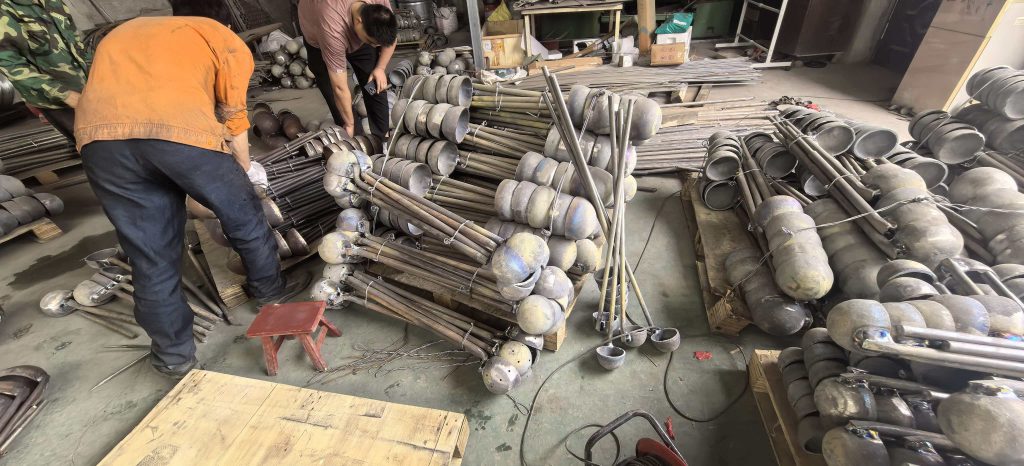
This case study presents a practical application example of titanium alloy sampling ladles used in rare earth molten metal sampling operations.
Customer Application Background
The application involved routine sampling during rare earth alloy production.
The production environment required sampling tools capable of handling:
- NdPr alloy molten metal
- La-Ce alloy molten metal
- High-temperature operating conditions
- Repeated sampling cycles
The customer required a solution that could provide:
- Stable sampling performance
- Good resistance to high-temperature exposure
- Reliable mechanical strength
- Improved operating efficiency compared with conventional tools
Initial Challenge
Before using customized titanium alloy sampling ladles, operators faced several common challenges found in high-temperature sampling operations.
1. Tool Durability
Repeated contact with molten rare earth alloys places significant stress on sampling tools.
Common problems include:
- Surface degradation
- Structural deformation
- Reduced service life
- Frequent replacement requirements
Long-term tool stability was an important consideration.
2. Operator Handling
Sampling operations are often repeated many times during production.
Heavy or poorly balanced tools may cause:
- Operator fatigue
- Reduced handling efficiency
- Difficulty maintaining consistent sampling procedures
A lighter and better-balanced design can improve daily operation.
3. Sampling Consistency
Stable sampling requires consistent tool performance.
Changes in:
- Tool condition
- Shape
- Surface quality
may influence sampling repeatability.
The customer needed a tool design suitable for continuous industrial operation.
Customized Titanium Sampling Ladle Solution
Based on the application requirements, a customized titanium alloy sampling ladle was developed.
The design considered:
Material Selection
Titanium alloy was selected because of its combination of:
- Corrosion resistance
- High strength-to-weight ratio
- Good mechanical stability
- Suitability for repeated high-temperature operations
Structural Design
The sampling ladle design was optimized according to operating conditions, including:
- Ladle head diameter
- Bowl depth
- Wall thickness
- Handle length
- Overall weight balance
The goal was to achieve a balance between capacity, durability, and operator control.
Application Matching
The final design was customized based on:
- Molten metal type
- Sampling requirements
- Furnace operation conditions
- Operator working distance
This approach helps avoid the limitations of standard-size tools.
Application Performance
During practical operation, the titanium alloy sampling ladle demonstrated stable performance in rare earth molten metal sampling.
Observed advantages included:
1. Reliable Repeated Sampling
The tool maintained structural integrity during repeated heating and cooling cycles.
This supported consistent sampling operations throughout production.
2. Improved Operation Efficiency
The relatively lightweight titanium alloy structure helped operators handle the tool more easily during repeated sampling tasks.
3. Extended Service Capability
Under the specific operating conditions, the sampling ladle achieved a cumulative sampling capacity of approximately:
4–5 tonnes of molten rare earth metal
before replacement.
Actual service life depends on:
- Molten metal composition
- Operating temperature
- Sampling frequency
- Operator procedures
- Furnace conditions
Key Factors Behind Successful Performance
The performance improvement was not caused by material selection alone.
Several factors contributed:
Correct Material Choice
The material was selected according to the application environment.
Proper Dimension Design
The ladle size was matched with the customer’s sampling requirements.
Customized Structure
The handle and bowl design were optimized for actual operation.
Understanding of Process Conditions
The tool design considered the complete working environment rather than only the product specification.
Lessons Learned From This Application
For rare earth production plants, selecting a sampling ladle should involve more than comparing prices.
Important evaluation factors include:
- Compatibility with molten metal
- Tool lifetime
- Operator safety
- Sampling consistency
- Long-term operating cost
A well-designed sampling tool can contribute to more stable production and improved process control.
Conclusion
Titanium alloy sampling ladles provide a practical solution for demanding rare earth molten metal sampling applications.
In NdPr and La-Ce alloy production environments, customized titanium sampling tools can help support:
- Stable sampling operations
- Improved operator efficiency
- Reliable tool performance
- Reduced replacement frequency
The best sampling solution should always be designed according to actual production conditions.
Need a Customized Titanium Sampling Ladle for Rare Earth Production?
We provide customized titanium alloy sampling ladles for:
- NdPr alloy production
- Lanthanum-Cerium alloy production
- Rare earth metallurgy
- High-temperature molten metal sampling
To recommend a suitable design, please provide:
- Molten metal type
- Working temperature
- Furnace opening size
- Required sample capacity
- Handle length
- Existing tool photos or drawings
Our engineering team can help develop a sampling solution based on your actual production requirements.